Featured Historical Article
Judicial Independence in Civil War Missouri:
The Removal of Judge John D.S. Dryden
Judge Mary Rhodes Russell
Judge John Debos Sharp Dryden (1862-1865)
Judge John Debos Sharp Dryden’s service on the Supreme Court of Missouri was landmarked by the unique and tumultuous time period of the American Civil War. His journey to the Supreme Court, and his removal from the bench was a product of the split loyalty of Missouri citizens between the Union and the Southern States. Fear of disingenuous loyalty to the Union led the “radical” party—who supported the Union—into passing sweeping ordinances meant to ensure the loyalty of all those who served and worked in the Missouri judicial branch. Judge Dryden, and the rest of the Supreme Court of Missouri, was no exception.
Early Life and Legal Career
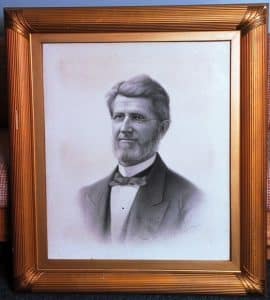
Judge Dryden was born on March 27, 1814, in Washington County, Virginia. In 1829, at the age of 15, his family moved to Warren County, Missouri, and began a family farm. Until he turned 18, Judge Dryden worked on the family farm while he attended school part time.
Judge Dryden went on to study law under Judge Mathias McGirk—the first Judge appointed to the Supreme Court of Missouri in 1820. In 1838, Judge Dryden was admitted to the bar and began practicing in Palmyra, Missouri. He continued to practice law in Northeast Missouri until 1862, and was often recognized by colleagues as one of the leaders of the bar in that area.
A Government in Turmoil
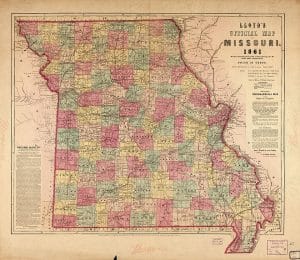
The Civil War erupted in 1861 and Missouri was deeply divided. There was strong support for both staying in the Union, and for supporting the southern states. In January 1861, the general assembly passed a bill allowing Missouri citizens to elect delegates to a state convention to determine Missouri’s status in the Union.
In March, the state convention voted 98-1 in favor of remaining in the Union. Although the convention was almost fully in favor of remaining in the Union, many citizens, including several holding offices in government sympathized with the southern states. One of which was Missouri’s Governor Claiborne Fox Jackson. Governor Jackson was elected in 1860 on a campaign of anti-secession but quickly reneged on this position and made several attempts to push Missouri into alliance with the southern states.
In June, General Nathaniel Lyon’s Union troops forced Jackson, and most of the state legislators supporting secession, to flee Jefferson City.
After Jackson fled, the state convention deemed the governor’s office, and many state legislative offices, to be vacant. As such, the state convention appointed Hamilton Rowan Gamble as governor of the provisional government of Missouri on August 1, 1861. Worry about loyalty to the Union persisted, and, in October 1861, the state convention adopted an ordinance requiring all civil officers to take and file an oath of loyalty to the Union and the State of Missouri.
The ordinance allowed all public office holders 60 days to take and file the oath, otherwise their seat would be vacated. It also gave Governor Gamble the authority to replace anyone who failed to file the oath as required.
Judges Dryden and Bay refused to acknowledge the new judges on the court and denied the validity of the Ousting Ordinance. In their view, they were duly elected and should not have to vacate their seats. As such, both Judges took the bench on June 12—notably an hour prior to when Court normally began—to begin calling cases and hearing oral arguments. Judge Dryden and Bay continued hearing cases unimpeded for the remainder of the 12th and the 13th.
On the 14th, however, Brigadier General of the Missouri Militia, D.C. Coleman, entered the courtroom and presented the judges with a letter from Governor Fletcher stating their seats were vacated and belonged to Judges Wagner, Lovelace, and Holmes. The letter clarified that the judges would be removed by force if necessary. This was also confirmed in a letter from Governor Fletcher to Coleman stating,
“In putting the judges [Wagner, Lovelace, and Holmes] into possession of the court room and clerk’s office, you will, as far as convenient in your judgment, avoid the use of violent means; but if in your judgment necessary, do not hesitate to employ all force it may require.”
Even in the face of the letter from the Governor, Judges Dryden and Bay refused to leave the bench. General Coleman left the courthouse and returned later that day with a squad of police officers from St. Louis. Upon his return, General Coleman again asked the judges to leave their seats, and, again, they refused. This time, however, General Coleman directed the police officers to remove Judge Dryden and Judge Bay from their seats. The police officers, armed with clubs and pistols, began moving toward the bench when Judge Dryden and Judge Bay finally stood up from their seats and attempted to leave the courtroom.
Life After the Supreme Court of Missouri
After the historic events of Judge Dryden’s service on the Supreme Court of Missouri, he would go on to private practice at his law firm Dryden & Lindsley in St. Louis. The partnership dissolved in 1871, at which point Judge Dryden practiced law with his son John at their firm Dryden & Dryden until his death.
Judge Dryden was remembered by the legal community as a distinguished lawyer with solidity, strength, and the soundness of his judgment rather than his skill in oratory. His obituary stated, “He was better fitted to plead before the bench than before the jury.” As a Judge, he was known for his ability and uprightness of his decisions. Others remembered him as a “formidable adversary” to face in the court room.
Judge Dryden’s Legacy
Judge Dryden is now remembered by the historic events that surrounded his service on the Supreme Court of Missouri. He was steadfast in his beliefs and the legality of his position as a judge as seen by his refusal to take a loyalty oath and his refusal to step down from the bench by order and demand of the Governor. Judge Dryden’s judicial service was a product of the extraordinary times that existed during the turmoil of the Civil War.
About the Author
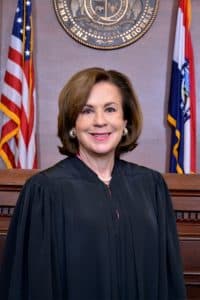
Mary Rhodes Russell is a judge of the Supreme Court of Missouri and currently its longest-serving member. Appointed to the Court in 2004, she was the third woman to serve on the Supreme Court of Missouri. She served as chief justice from July 2013 through June 2015 and again from 2023 to 2025, becoming the first woman in Missouri history to serve two terms as chief justice.
President’s Perspective
Judge Robert M. Clayton III

The Supreme Court of Missouri Historical Society was created in 1983 with the inspiration and support of Supreme Court Judge Warren D. Welliver. His vision was to create an independent, nonprofit organization to recognize and reflect upon the unique role of the Supreme Court of Missouri in the history of our state and nation. Over the years, the Society has provided support to important research into the lives and legacies of past judges and the legal issues that contributed to our history. The Society has participated in past efforts of supporting young legal scholars through internship programs, invested in research into historical topics, and financially supported the Supreme Court in preserving judge portraits and creating the Judicial Discovery Center.
As we look to the future, we hope to modernize our communication techniques to invite others to participate in the Society’s work. Whether conducting programs of continuing legal education, supporting further improvements in the Court’s physical space or supporting research of scholars and students, our future opens many possibilities of membership to further study the Court’s legacy.
We welcome you to our first modern newsletter, highlighting the work we have accomplished so far and what still lies ahead. Our first issue contains exciting information about the benefits of membership, our annual dinner in November, and future cooperative efforts to document and discuss our state’s legal history.
Our Society is governed by a board of trustees with an active committee organization. There are opportunities to participate in many ways, whether heavily engaged or simply providing good governance. Please reach out to one of our trustees should you have questions about the Society and how you can be a part of history – as it happens.
Robert
Society News
Historical society receives Judicial Excellence Award for Improving Public Trust and Confidence
Beth Riggert
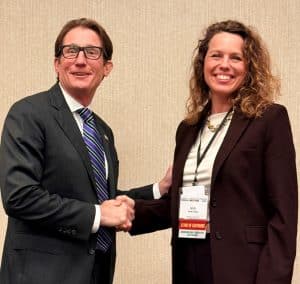
On Constitution Day (September 17), Missouri Chief Justice W. Brent Powell presented the Judicial Excellence Award for Improving Public Trust and Confidence to the Supreme Court of Missouri Historical Society for its “invaluable role” in completing the state’s Judicial Discovery Center.
The center, which had its grand opening earlier in the week, is a “one-of-a-kind educational exhibit that showcases the judiciary’s history and promotes civic responsibility with the next generation,” Powell said.
He made the presentation in Kansas City during the annual awards ceremony of the Judicial Conference of Missouri, the organization of all the state judges. Accepting the award on behalf of all those in the historical society whose efforts made the Judicial Discovery Center a reality was the society’s treasurer, Jefferson City attorney Heidi Doerhoff Vollet.
Supreme Court of Missouri Celebrates Constitution Day Early with Grand Opening of Judicial Discovery Center
Beth Riggert
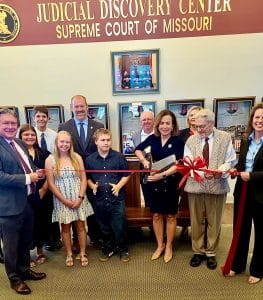
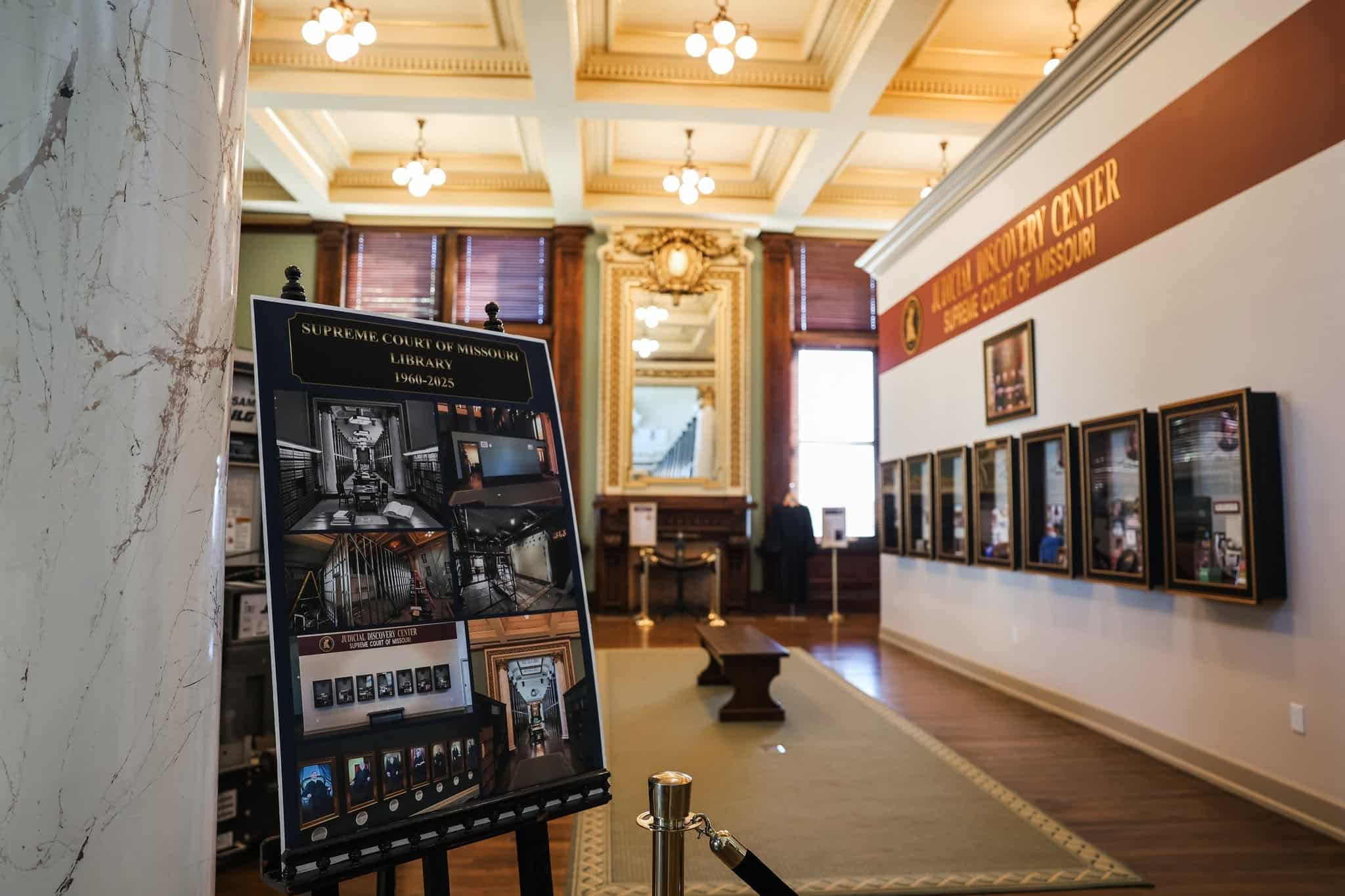
JEFFERSON CITY, Mo. – The Supreme Court of Missouri has celebrated the grand opening of its Judicial Discovery Center, an interactive space for visitors to learn more about the rule of law, the role of courts in our system of government, how judges decide cases, and careers in the courts.
Reflecting its civic education mission, the center’s opening – held Monday morning, September 14, 2026 – was timed as an early recognition of Constitution Day, observed September 17 each year to commemorate the signing of our nation’s constitution. But the center’s origins date back decades.
In 1982, when then-Supreme Court of Missouri Judge Warren D. Welliver founded the Supreme Court of Missouri Historical Society, he envisioned a “Museum of Justice” in the building, explaining, “We have these wide open halls here in the building, and I think that we can create something that will be of great interest to the many school children that tour this building.”
During this morning’s ceremony, Supreme Court of Missouri Judge Mary R. Russell said the Judicial Discovery Center has expanded well beyond what Welliver first imagined.
“All of us at the Court long have recognized the importance of civic education, and who better to explain how courts work and judges make decisions than us?” Russell said. “But getting the Judicial Discovery Center from concept to reality was not easy. We knew it was too important to be something to pass by in the hall. We wanted a dedicated space to come alive for visitors, with interactive exhibits and hands-on opportunities for learning about the courts. Once the availability of electronic materials greatly reduced our need to house physical books and journals, we realized we could convert the east wing of this beautiful law library into our Judicial Discovery Center.”
Russell described the yearslong process: touring learning centers at courts around the country, considering what would set Missouri’s approach apart, narrowing down ideas, then pairing Court staff expertise with vendors who could bring the concepts to life.
“The result today is so much better than anything any of us ever imagined,” Russell said. “I admit I found the pace frustrating at times, but as they say, the best things in life are worth the waiting. I could not be prouder of what we have accomplished here, and I am so excited for people to experience it for themselves.”
The Judicial Discovery Center would not have been possible, Russell said, without the Supreme Court of Missouri Historical Society leading a capital fundraising campaign.
“This project is the most important the society ever has undertaken,” society President Robert M. Clayton III, also a Missouri Court of Appeals judge, said. “It fulfills multiple missions of the society – to preserve this historic building, to establish educational facilities for the public, and to disseminate knowledge of the Court and its place in our history. I am so grateful for the many donors whose more than $400,000 in contributions made this amazing space possible for generations to come. I’d like to think Judge Welliver would be proud of what we have accomplished together.”
The society previewed the Judicial Discovery Center during a reception before its annual dinner last November. The Court since has led visitors through the space, using their feedback to shape additional exhibits – the last of which were installed two weeks ago.
In remarks prepared for the event and shared by a staff member, Betsy Ledgerwood, clerk of the Court, noted: “The feedback we’ve received so far has been incredibly positive. Visitor highlights have included our videos, in which judges in portraits ‘come to life’ and talk about what it means to be a judge, as well as the personal mementos in our judges’ shadow boxes, from photos and sports memorabilia to scouting badges and a blonde Lego judge made by one judge’s son. But my favorite part is reaching not only people’s minds but also their hearts, as they realize courts are here for them, judges are just people too, and kids can see themselves growing up someday to work in our courts.”
As part of the event, high school students from New Franklin toured the new space and participated in the ribbon-cutting ceremony. They were chosen given a unique historic connection between the Court and the local schools there. In March 1821, the Court held its first session in Franklin. Its clerk for the judicial district was Gray Bynum, who also helped found the first school in the area and was its first teacher.
Reflecting on the event, Parker Gross –New Franklin High School’s government teacher – said his students found the whole center very approachable, and nearly every one learned something new. They particularly enjoyed the video experience and thought the interactive exhibits were helpful in introducing ideas and concepts about the judicial system, especially for anyone who doesn’t know much about it and for younger students. Gross reported four of the students said, after looking through everything in the center, they are more interested in the idea of law school!
The Judicial Discovery Center is open during normal business hours. Free guided tours, lasting approximately one hour, may be scheduled on the half-hour from 9 to 11 a.m. and 2 to 3:30 p.m. Monday through Friday, excluding public holidays and when the Court is scheduled to hear oral arguments. Reservations are preferred for all groups and are required for groups of 10 or more. To schedule a tour, please call (573) 751-7331 or e-mail Tours.Calendar@courts.mo.gov.
The Judicial Discovery Center is part of the Court’s ongoing civic education efforts. More resources are available through the Discover Missouri Courts website (https://www.courts.mo.gov/CivicEducation), and judges throughout the state are available to make presentations to schools and civic groups.
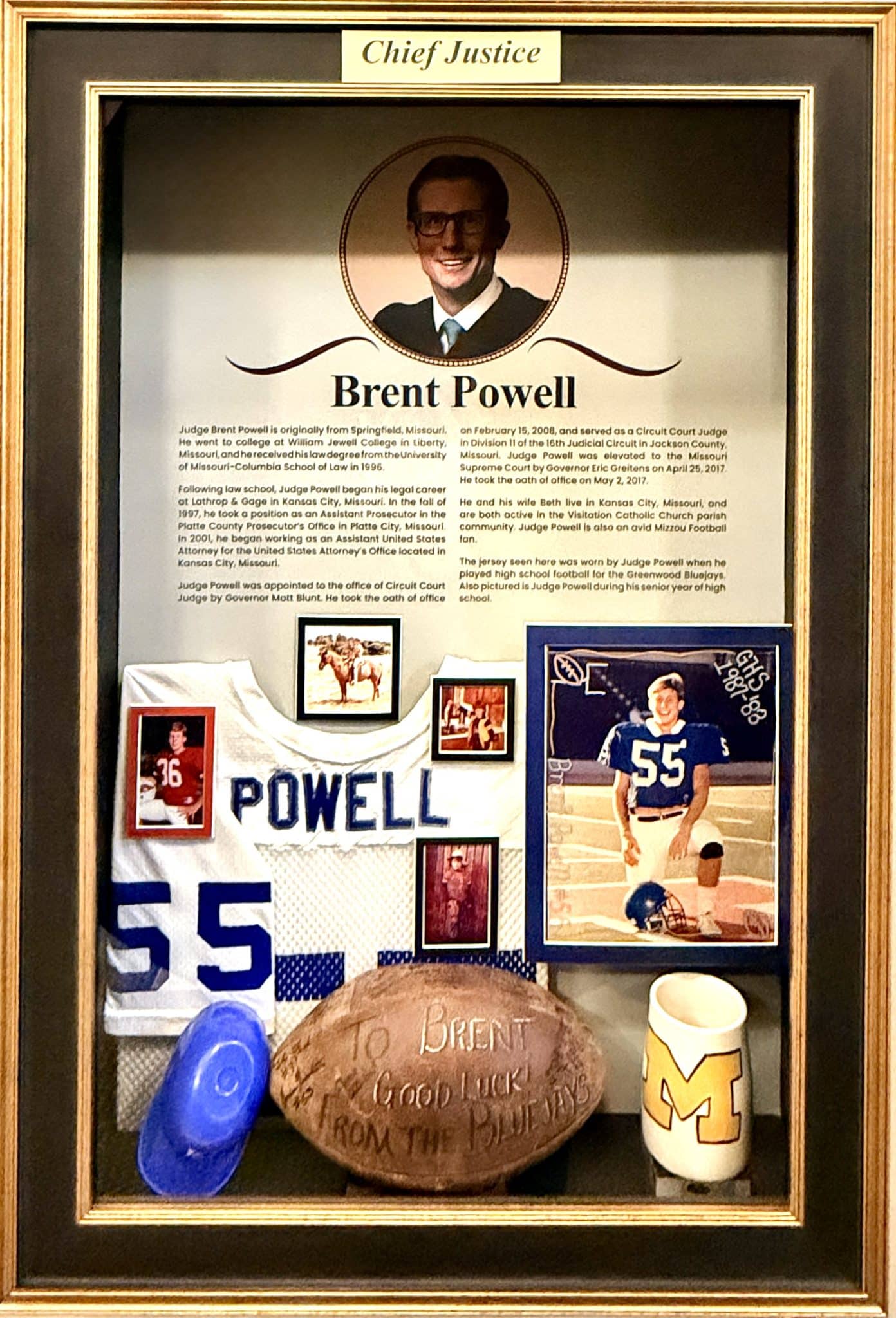

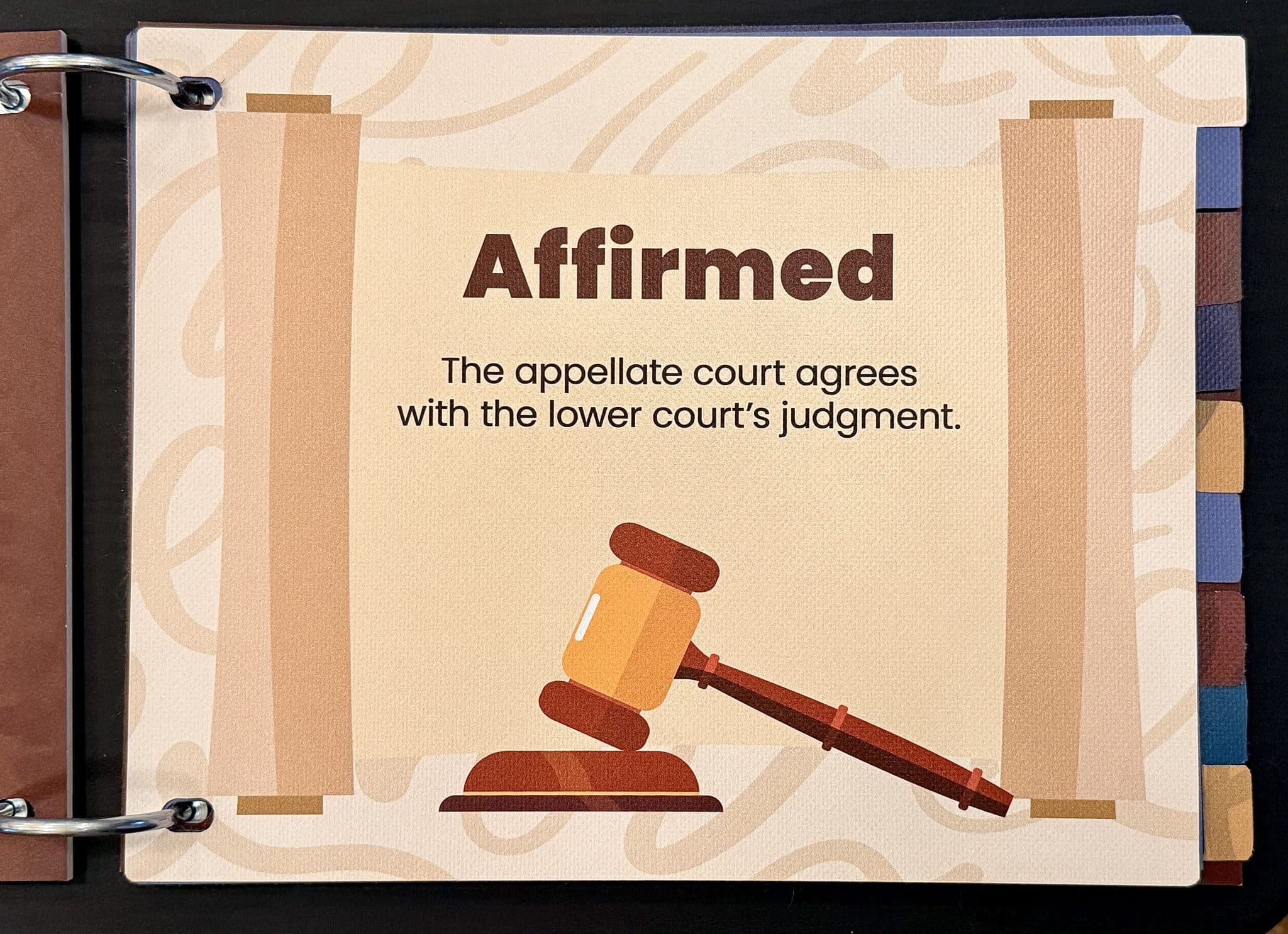
Learn more about the Judicial Discovery Center through the Court’s most recent episode of the Missouri Law Matters podcast, from the Court’s YouTube channel (https://www.youtube.com/@SupremeCourtMO/podcasts) or wherever you prefer to get your podcasts.
About the Author

Beth has served more than 25 years as the Supreme Court of Missouri’s communications counsel and a trustee of the Court’s historical society for more than a dozen years. She also is a former president of the Conference of Court Public Information Officers, the international organization of professional court communicators. When she finds spare time, she enjoys traveling with her husband.
Annual Dinner Celebrates 250 Years of American Constitutional History
Jonathan Sternberg
On Wednesday, November 4, 2026, members of the bench, bar, and community will gather in the Supreme Court Building in Jefferson City for the Supreme Court of Missouri Historical Society’s Annual Dinner.
This year’s dinner comes at a particularly fitting moment. As our nation marks the 250th anniversary of the Declaration of Independence, the Society will welcome Professor Carli N. Conklin of the University of Missouri School of Law and Kinder Institute on Constitutional Democracy. Professor Conklin’s presentation will connect the Declaration and the ideas of the American founding with Missouri’s own constitution and courts.
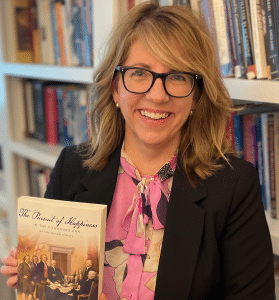
Few scholars are better suited to the subject. Professor Conklin is an Associate Professor of Law, Kinder Institute Associate Professor of Constitutional Democracy, and Director of the School of Law’s Center for the Study of Dispute Resolution. She holds a J.D./M.A. and Ph.D. in American Legal History from the University of Virginia, and her research focuses on early American legal and intellectual history. Her award-winning book, The Pursuit of Happiness in the Founding Era: An Intellectual History, examined the meaning of one of the Declaration’s most enduring phrases. Her scholarship during this anniversary year has continued that work, including studies of the Declaration, the pursuit of happiness, and the purposes of government.
Professor Conklin follows a distinguished group of recent Annual Dinner speakers, including Judge Duane Benton, Senator John Danforth, Governor Jeremiah “Jay” Nixon, Attorney General John Ashcroft, and Judge Stephen N. Limbaugh.
The Annual Dinner is also an opportunity to celebrate the work that continues throughout the year. Since 1983, the Historical Society has worked to preserve the history of the Supreme Court of Missouri and our state’s judicial system, encourage historical research, preserve the Supreme Court Building and important artifacts, and make Missouri’s rich judicial history better known and understood.
That history tells the story of the institutions, judges, lawyers, litigants, and ideas that shaped the law of Missouri and continue to influence it today. Preserving that story requires an engaged community committed to carrying it forward.
We hope you will join the Society on November 4 for an evening of history, fellowship, and conversation – and help us preserve Missouri’s judicial heritage for generations to come.
Get Your Tickets Here
About the Author

Jonathan Sternberg is an appellate attorney based in Missouri. He is the founder of Jonathan Sternberg, Attorney, P.C., with offices in both Kansas City and St. Louis.
The Inauguration of a Missouri Legal History Research Initiative
In early 2024 Kenneth H. Winn, PhD, began exploring the idea of writing a series of scholarly but readable Missouri legal history essays for lawyers and the general public. He had been thinking about Missouri legal history for many years. His past work, including Missouri Law and the American Conscience, has been cited in many legal publications and briefs.
To support this initiative, the Supreme Court of Missouri Historical Society offered a foundational grant. He has also received funds from the Freedom Suit Memorial Foundation, a Foley Fellowship from the Friends of the Missouri State Archives, and now works with two research associates.
The first essay in this series is “Missouri Supreme Court Judge Ernest Tipton and the Dazzling Criminal Career of His Sister Nellie.” A second essay involves the early Missouri Supreme Court and the slave trade; a third examines the colorful legal culture of antebellum Missouri, with a second part noting the violent duels that exploded outside of the courtroom and on the “field of honor.” The series will also include biographical sketches of important judges and lawyers who practiced on or before the Supreme Court.
Missouri Supreme Court Judge Ernest Tipton and the Dazzling Criminal Career of His Sister Nellie
Kenneth H. Winn
Judge Ernest Tipton and the Pendergast Machine
Siblings of prominent politicians have long embarrassed their prominent brothers and sisters. Often politicians need little family help to embarrass them, but to cite only some recent presidential examples, Richard Nixon had “Poor damn dumb Donald”; Jimmy Carter had “Billy Beer” Carter, the failed Libyan agent; Bill Clinton had his drug-trafficking brother, Roger. Siblings plague ordinary people, too, but their misdeeds rarely make news.
Missouri Supreme Court Judge Ernest M. Tipton was not as famous as a president, but few politicians have been quite so flamboyantly embarrassed as he was by his narcissistic sister.
He nevertheless remained loyal to her past the edge of judicial ethics. Tipton was a handsome, broad-faced, distinguished-looking man. He looked a lot like what a mid-twentieth century Chief Justice of the Missouri Supreme Court was supposed to look–something he eventually became.
Tipton was born on January 2, 1889, in Bowling Green, Missouri, to a Confederate Civil War veteran and popular Baptist minister, the Reverend William R. Tipton, and his wife, Mollie Moss Tipton. Ernest, or “Tip” to his friends, attended Columbia public schools and then matriculated at the University of Missouri where he graduated with a Bachelor of Law degree in 1911. He was admitted to the bar that same year.
Tipton was extremely competitive by nature, and he had three great passions. The first was football. He was a star quarterback for the University of Missouri Tigers and belonged to an elite campus sports organization called the “M Club.” After his graduation he coached football at Westminster College in Fulton, Texas Christian University in Fort Worth, and East Texas Normal School in Commerce (now East Texas A&M University). As an alum he attended MU football games with an ardent devotion and served as an amateur referee while sitting on the Court.
A second interest was raising purebred Angus cattle, which Tipton showed competitively. While on the Supreme Court he maintained a fifty-acre ranch just east of Jefferson City, and he served on the board of directors of the American Angus Association.
His third, and strongest, passion, however, was politics. Tipton had immediately joined the bar on his graduation from college. He had started his law practice in Fulton but eventually moved it to Kansas City. There Tipton became a colleague and life-long friend of Kansas Citian Clay C. Rogers, a Pendergast political machine-connected lawyer. He served on the State Board of Law Examiners between 1923 and 1930.
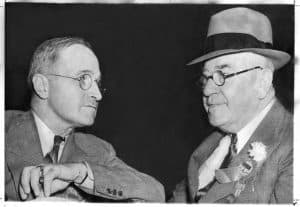
As a sitting judge Tipton actively campaigned for Democratic candidates, even after the adoption of Non-partisan Court Plan in 1940 forbade such activities. Just when Tipton joined Kansas City Boss Tom Pendergast’s political machine is unclear–certainly by the early 1920s–but when he jumped in, he did so with both feet and quickly climbed its organizational ladder. Through his Pendergast connections Tipton met Harry S. Truman, with whom he maintained a life-long friendship.
In 1932 Pendergast supported Ernest Tipton’s candidacy for a seat on the Missouri Supreme Court. Tipton had several advantages that year. Most importantly, it was the darkest of the dark Depression years. Franklin Roosevelt buried the hapless Republican President Herbert Hoover in a landslide, leading thousands of Democrats nationwide to their own victories. But just as meaningfully, Tom Pendergast could manufacture literally unbelievable vote totals in Kansas City and Jackson County that could carry any state margin.
In Tipton’s case, Harry Truman, then a Jackson County Judge (an administrative position), was there to help as well. Tipton received nearly seventy percent of the Kansas City/Jackson County vote, and he would serve on the Court for the next twenty-two years.
The Ministering Angel: The Trials of Nellie Muench
“Goldie’s” gang had kidnapped Kelley almost two years before Ernest Tipton joined the Missouri Court. In the years of trouble that lay ahead, Nellie and her attorneys frequently turned to Tip and other members of the Court for help. Early on this was successful. When, for example, after Nellie’s arrest, the prosecutor decided she was a flight risk, her initial bond was revoked on a Sunday morning. Her attorneys, accordingly, zoomed off to the Missouri Supreme Court in Jefferson City. There they found Judge Ernest Gantt in his chambers. (Tipton’s location had gone unnoted). Gantt obligingly issued a writ of habeas corpus and cut her bail in half.
Nellie’s defense also tried to get Senator Harry Truman involved. A letter from Truman’s personal attorney and Pendergast operative Rufus Burrus sought the Senator’s help. On March 23, 1935, Truman responded that he was doing what he could, but this “situation…is loaded with dynamite and I am of the opinion that there is very little that can be done from this end of the line. You, of course, know my feeling for Judge Tipton, and I will be pleased to do anything I can to help,” but he was convinced he could do little.
The kidnapping accusation against Nellie played against the era’s female stereotypes. As a well-thought of society lady and doctor’s wife Nellie’s sensational case became the talk of St. Louis, making a change of venue for her trial appropriate. Circumstances, however, suggest that the change of venue to the central Missouri town of Mexico, near Columbia, was no accident. And even there her case was a spectacle, with people lining up at 6 a.m. to get seats in the courtroom. Like a mobster, Nellie hid her face from photographers. (She later threw powder at them to distort their pictures.)
Tip loyally sat by her side keeping an eye on circuit court judge, W. C. Hughes, who conducted the trial. She was certainly well defended, as she had thirteen lawyers work for her without a fee. The group was led by Tipton’s old Pendergast colleague, Clay Rogers, but it also included a former Mexico circuit judge; a Mexico State Senator; and, importantly, a former state Representative, named Pross Cross, who had once served as the Democratic Party floor leader. If that was not sufficient support, the local sheriff created a jury pool composed only of his personal friends.
At the trial her lawyers railed against press persecution (especially that of the St. Louis Post-Dispatch). It was big city ruthlessness directed at a simple country girl. It did not hurt her defense that the hefty snitch, Fielder, had already been convicted of perjury multiple times. Then there was her sex. Clay Rogers asked, would professional criminals take a woman into their confidence? She was no villain. When Nellie shed tears entering the courtroom, Pross Cross said it showed a “heart laden with sympathy and love of humanity.” Despite the cruel accusations against her, said Cross, she was, in reality, “a ministering angel with a heart of gold.”
While Nellie and her attorneys lauded her and her family’s respectability, Nellie could swear a lusty blue streak—at neighbors, reporters, or anyone else who crossed her. Cross, however, easily explained this unfortunate attribute away. Life had handicapped her by making her a redhead. He acknowledged that she was “hot tempered, quick to speak up in answer to insult, but that is her nature and she can’t help that.” (A bottle of henna helped bring out her acerbic streak.)
The greatest surprise of the trial, however, happened before it even began.
To the amazement of many, the forty-three-year-old Nellie gave birth just prior to its commencement.
With a new baby needing her care, how could a jury heartlessly put his mother in jail? She needed to be restored to her home so she could continue her angelic ministry to her new baby. Happily, for Nellie, her attorneys proved convincing. The lies others had told about her crashed upon “the rugged honesty of a jury of typical Missourians,” and she was acquitted.
Unfortunately, her baby’s unexpected birth was puzzling to even those who knew her well. She had kept her pregnancy a secret, she said: quite successfully. The nature of her motherhood—both metaphorical and literal, however, came into question when a nineteen-year-old Philadelphia servant girl, named Anna Ware, announced that Nellie’s child was really hers. To avoid embarrassment, the child’s father, Ware’s wealthy employer, had quietly sent her to St. Louis to give birth to their illegitimate child. Ware claimed that with the aid of a lawyer Nellie had tricked her out of her baby. Ten days after the Mexico court case, a hearing began at the Missouri Court of Appeals—Eastern District to determine the baby’s mother. An attempt by Nellie’s attorneys to get the Missouri Supreme Court to stop the hearing failed. (Judge Tipton recused himself from the decision.)
Because of the case’s controversiality, the Court of Appeals turned to an outsider, appointing Cape Girardeau attorney, Rush Limbaugh, Sr., as a special commissioner (judge) to investigate the matter. Nellie was vigorously represented by Kansas Citian Edgar J. Keating, another Pendergast-affiliated lawyer.
The hearing proved even more sensational than the kidnapping trial, capturing nationwide notice as “the baby hoax.”
During the hearing, the defense counsel tried to enlist the Supreme Court to first remove Limbaugh as special commissioner. When that failed, they asked the Court to prevent the baby being examined by doctors in Limbaugh’s courtroom. When the Court proved unexpectedly slow in responding to Nellie’s request to block the examination, the press and public went wild. The suspense was palpable. The reason for the Court’s delay went unexplained, but in the end it refused to interfere with Limbaugh’s decision.
After weeks of melodrama, Limbaugh ordered the baby be removed from Nellie and placed in the court’s custody. Nellie responded to his decision with hysterics, screaming about the loss of her child and swearing obscenities. She had to be forcibly removed from the courtroom. Shrieking as she went, she called Ware “that little bitch, whore,” and struck a newspaper reporter on her way out. In the end, Edgar Keating was defending the indefensible, and Limbaugh ordered the child restored to Anna Ware. The Missouri Supreme Court later affirmed Limbaugh’s decision.
The Badger Game
“Persecuted” though she was, Nellie’s incorrigible conniving knew no bounds. Later, before it became clear that the disputed baby belonged to Anna Ware, Nellie had begun a new scam. She had recently taken a lover, a colleague of her husband, named Dr. Marsh Pitzman.
This was the start of a new con popularly known as “The Badger Game.”
She told Pitzman that the child she bore was really his. To help her with her legal fees and avoid publicity, he quietly gave her at least $16,000, probably considerably more. Nellie thought she might eventually be able to run it up to a couple of hundred thousand. When Pitzman informed authorities that she had conned him out of his money, she was charged in federal court for mail fraud and convicted in November 1936.
On December 23, 1936, Nellie unexpectedly confessed her crimes to a St. Louis Post-Dispatch reporter. It was true, she lamented, she was a “hussy.” “I have disgraced my brother and ruined my husband.” On December 26 she contritely begged the judge for mercy but was shown none. She was given a ten-year-prison term. Her husband; Jones, the attorney who helped “hoax” Ware out of her baby; and one of Nellie’s friends who had vouched for her pregnancy, also received sentences.
In July 1937 Nellie began serving her time at the Federal Detention Farm in Milan, Michigan, before being transferred to a prison in Alderson, West Virginia. Unsurprisingly, Ludwig Muench divorced her. Upon her 1944 release she moved to Jefferson City where, for a time, she secretly lived with her brother. She then relocated to Kansas City. She lived a much quieter life there in a rooming house under an assumed name until her death in 1982 at age 91.
Judge Tipton Redux
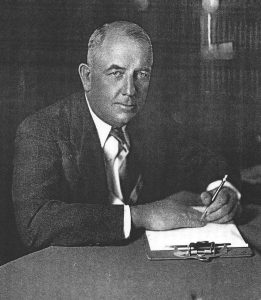
How much trouble Nellie’s misadventures caused Judge Tipton is hard to determine, but they caused him some. In 1940 Judge Tipton longed for an appointment to the Federal Eighth Circuit Court of Appeals and was relying on Senator Harry Truman to help him obtain it. In a letter to Truman the prominent Kansas City lawyer James E. Nugent acknowledged that the gossip about Nellie had been a source of anguish for Judge Tipton, but urged that her waywardness not reflect on her brother.
Tipton campaigned vigorously for the position. His allies besieged Attorney General Robert Jackson, who himself would soon be a U.S. Supreme Court Judge. They were told that the Eighth Court appointment would go to a Missourian, but they had made no decision. One of Jackson’s top assistants, however, assured Tipton’s friends that the Muench affair would not be held against him. Correspondence shows Truman did his best for Tipton. But the appointment when it came went to another of Harry Truman’s close friends, John Caskie Collet–another Pendergast-connected Missouri Supreme Court Judge.
This disappointment aside, Tipton’s star had not completely faded.
He had a long-developed interest in railroad law. In 1943 President Franklin Roosevelt named him to the National Railway Labor Panel.
Whatever happened behind the scenes, Tipton and Truman maintained their warm friendship. As President, Truman asked Tipton to serve in several other special capacities involving labor disputes, including a threatened national strike of railroad conductors. Tipton was also instrumental in helping pave the way for Winston Churchill’s joining Truman at Westminster College in March 1946. There Churchill delivered his famous “Iron Curtain” speech. After Truman left the White House Tipton chaired the fundraising effort to create the Harry S. Truman Presidential Library.
Tipton would serve on the Missouri Supreme Court for the rest of his life. He won two retention votes under the non-partisan court plan, but died of a heart attack at 66, on February 25, 1955. At the time he was serving his third term as Chief Justice. In the end he could not fully escape Nellie. Gossip about his sister’s escapades followed him even into his obituary in hometown newspaper, the Jefferson City News-Tribune. Curiously, Nellie’s principal nemesis, the St. Louis Post-Dispatch, merely noted her as one of her brother’s survivors.
About the Author

Kenneth H. Winn, PhD, is the author or editor of numerous works on Missouri legal history, including Missouri Law and the American Conscience. He is a former trustee of the Supreme Court of Missouri Historical Society and currently serves on the board of the Freedom Suits Memorial Foundation.
In Memoriam
Richard S. Brownlee III
Melissa Largent

The Supreme Court of Missouri Historical Society was founded in 1983, and Richard S. Brownlee III joined the Society just five years later, in 1988. He immediately took on a leadership role, serving as President for two years, and remained an active and dedicated Trustee of the Board for the rest of his life. Over the decades, he continued to serve the Society in a variety of officer positions, providing steady leadership, institutional knowledge, and an unwavering commitment to its mission. His service spanned nearly four decades and continued quite literally until the end – he remained actively engaged in the Society’s work just weeks before his passing in December 2025, leaving a lasting legacy within the Society and among those who had the privilege of serving alongside him.
Support the Society
The Missouri Supreme Court: From Dred Scott to Nancy Cruzan
 The Society commissioned the first complete history of the Supreme Court of Missouri. The hardcover book, by St. Louis University School of Law Professor Emeritus Gerald T. Dunne, is The Missouri Supreme Court: From Dred Scott to Nancy Cruzan, published by the University of Missouri Press.
Available for Purchase
Why Join the Supreme Court of Missouri Historical Society?
Stay connected to Missouri’s rich judicial history through the Supreme Court of Missouri Historical Society. Members can explore historical resources through the Society’s website, register for educational events and CLE programs, support the Society’s mission to preserve and promote Missouri’s judicial heritage, and stay informed about ongoing projects and initiatives. Membership is based on the calendar year, with annual dues payable by March 1. As the Society looks ahead to a membership drive beginning in 2027, now is an excellent time to become involved and help strengthen a community dedicated to education, scholarship, and public engagement.